
Updated on 24. September 2026
A compact look at the advantages for the chemical industry.
In chemical warehouses, barcode or RFID systems have often been considered the established standard for decades. What was once regarded as a step toward automation turns out, on closer inspection, to be a quiet drag on efficiency and safety. Especially with high pallet throughput, complex hazardous material zones, and growing SAP integration requirements.
Summary:
Challenge: Modernizing Outdated Technologies
Large-scale market shifts are driving change across manufacturing companies and the logistics industry: customers expect faster and faster delivery with a smaller ecological footprint, within increasingly complex global supply chains. Solutions are emerging through technological progress — IoT, AI, and autonomous forklift trucks promise optimized workflows in the global marketplace. Integrating these technologies into warehouse operations brings numerous challenges, from fail-safe operation and data security to the question of return on investment (ROI).
In the chemical industry, there’s an additional factor: many warehouses are running on systems that were considered state of the art 15 or 20 years ago and have barely been fundamentally updated since. This creates a growing gap between what is technically possible and what actually happens in day-to-day operations.
What Classic Scan Systems Really Mean in a Chemical Warehouse
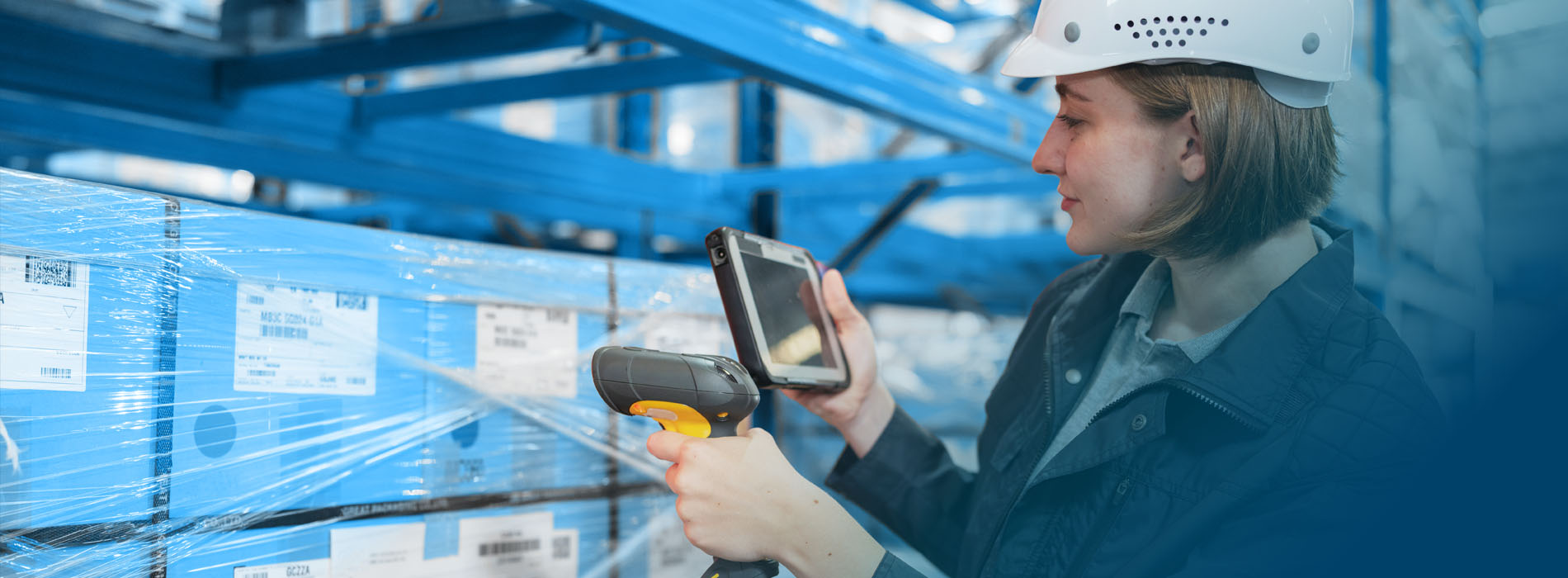
In practice, an RFID or barcode system looks like this: the forklift operator drives to the conveyor belt, stops, brings the forks into a defined scan position, manually triggers the read process, waits for system confirmation, repositions the forks, picks up the pallet and repeats the entire process in reverse when setting it down.
This is the standard process in warehouses with traditional scan systems. Every single pallet movement requires multiple manual interaction steps. What gets lost in the process is time — just a few seconds per handling cycle, but a significant amount over the course of a full year.
With a pallet throughput of 250,000 units per year and a time saving of just 5 to 10 seconds per movement, the potential translates directly into several hundred thousand euros in annual operating costs.
Comparison:
| Classic RFID/Barcode | LiDAR-WES |
|---|---|
| Drive up → Stop | Drive up |
| Position forks | Conveyor belt captures automatically |
| Manually trigger scan | Forklift picks up pallet |
| Wait for system confirmation | System books automatically |
| Reposition forks | Done |
| Pick up pallet | |
| Set down → scan again |
The Unique Challenges of Chemical Logistics
What works in conventional distribution warehouses quickly reaches its limits in the chemical industry. This comes down to several structural characteristics:

Large-Scale Block Storage with High Throughput
Petrochemical and polymer-producing companies typically operate large block storage facilities with very high pallet throughput. Every second a forklift operator spends on system interactions multiplies accordingly.

Explosion-Protection Zones, Hazardous Material Classes, and Co-Storage Restrictions
Chemical warehouses are typically divided into storage zones: by hazardous material class, explosion-protection areas, and legally mandated co-storage restrictions. These zones don’t just need to exist physically; they need to be actively monitored during ongoing operations: Which pallet is where? Is it allowed to be there? Is a co-storage restriction being violated? Classic RFID or barcode systems cannot provide a reliable real-time answer to these questions. A LiDAR-based WES, on the other hand, knows the exact position of every pallet at all times and can automatically detect and flag violations before they become a problem.

Chemical Stress on Hardware
Dust, moisture, chemical vapors, and residues put significant strain on barcode labels, RFID tags, and readers. In practice, this means: read failures, manual re-entry, and data losses in the ERP system.
High Product Variability and Critical Batch Traceability
Granules, powders, liquids, big bags — different packaging formats make standardized scan positions difficult. At the same time, every batch must be unambiguously traceable. Misloading events in this environment are not minor issues; they can cause production disruptions, customer complaints, or in the worst case, safety-critical consequences.
Growing ERP Integration Depth
Many chemical companies are currently in the middle of migrating to SAP S/4HANA. Legacy scan systems built on outdated SAP R/3 data communication pathways are difficult to integrate cleanly into this new architecture.

Analoge, manuelle Prozesse
Gerade bei hohem Durchsatz im Blocklager entstehen Zeitverluste von wenigen Sekunden pro Bewegung. Die sich auf sechsstellige Beträge pro Jahr summieren können.
Komplexe Lagerumgebungen mit hohen Sicherheitsanforderungen
Großflächige Indoor- und Outdoor-Lager, explosionsgefährdete Zonen (ATEX), Gefahrstoffbereiche und unterschiedliche Temperatur- oder Sicherheitsanforderungen erschweren eine durchgängige Transparenz. Staub, Feuchtigkeit oder chemische Rückstände setzen herkömmlicher Scan- und RFID-Infrastruktur zusätzlich zu.
Hohe Produktvarianz bei gleichzeitig kritischer Chargenführung
Granulate, Pulver, Flüssigkeiten, Big Bags oder Spezialcompounds – unterschiedliche Aggregatzustände und Verpackungsformen erfordern differenzierte Lagerstrategien. Gleichzeitig muss jede Charge eindeutig rückverfolgbar bleiben. Bereits kleine Verwechslungen führen zu Produktionsstörungen oder sicherheitsrelevanten Risiken.
Why the Classic System Has Reached Its Technological End
The problem isn’t that RFID or barcode are fundamentally poor technologies. The problem is that they were designed for a different warehouse environment and that their structural limitations are becoming increasingly apparent as throughput grows, requirements tighten, and cost pressure rises.
Specifically:
- RFID systems with floor markings or rack-mounted antennas require significant interventions in the warehouse infrastructure. Every structural change, every site relocation means reinstallation from scratch.
- Barcode systems depend on line of sight. In chemical warehouses with dust exposure, challenging lighting conditions, or uneven surfaces, this is a persistent operational problem.
- Both technologies tie the forklift operator into every individual step. Genuinely relieving operators of manual system interactions is structurally impossible with these approaches.
The positioning accuracy of classic near-field systems is often insufficient for the demands of modern block storage — especially when multiple product variants are stored in close proximity.
The Alternative Approach: LiDAR-Based Positioning Without Infrastructure Modifications
A Warehouse Execution System based on LiDAR sensor technology works on a fundamentally different principle: position detection is handled entirely visually by the LiDAR sensor mounted on the forklift truck. No floor tags, no rack antennas, no near-field communication infrastructure is needed.
What this means in practice:
Automatic Initial Capture — No Manual Interaction Required After That
At the conveyor belt, every pallet is automatically captured and registered in the system. From that moment on, the WES takes over completely: it knows which pallet is on which forklift truck and tracks all subsequent movements automatically. At no point does the forklift operator need to stop, manually trigger anything, or confirm anything on a display.
Centimeter-Accurate Positioning
LiDAR-supported systems achieve a positioning accuracy of 5 cm in practice — far more precise than any RFID-based solution. This is especially relevant in chemical warehouses with high product variability, where unambiguous storage positions are critical.
No Infrastructure Modifications
Since neither floor markings nor rack antennas nor trigger sensors are required, the costly and time-intensive infrastructure buildout is eliminated entirely. This makes the solution particularly attractive for chemical companies with multiple sites looking to scale a uniform solution.
Zero Misloading Rate
A LiDAR-guided WES automatically detects when the wrong pallet has been picked up or set down in the wrong location. The system issues an alert before the error occurs — or logs the new storage position accordingly. In petrochemical and specialty chemical operations, where incorrect batch assignments can have far-reaching consequences, this is a decisive advantage.
What This Means for Onboarding New Employees
An often-underestimated factor: classic scan systems require intensive training in operating procedures, system interactions, and manual process steps. Every new employee has to learn when to scan, how to position themselves, and how to operate the ERP system correctly.
In a LiDAR-based WES, the forklift operator drives. The system handles the rest. In practice, this means: employees with no prior knowledge of the warehouse system become productive in under an hour — even if they’ve never worked with a system like this before. This isn’t a theoretical figure; it’s operational reality from a petrochemical warehouse.
Conclusion: The Age of Technology Is Not a Quality Indicator
A 20-year-old RFID system that works feels like stability. In reality, it’s a silent cost driver — in the form of time losses, infrastructure overhead, misloading risks, and increasingly difficult ERP integration.
Chemical logistics operations that rely on classic scan systems are competing in a world where fully scan-free, LiDAR-based processes with 5 cm accuracy are already operational reality. The switch is not a question of technology affinity — it’s a question of competitiveness.
Frequently Asked Questions (FAQ) on RFID/Barcode Systems and Alternatives in Chemical Logistics

SAP WM® to SAP EWM® or a Fresh Start? Without Valid Warehouse Data, Nothing Works!
Why Classic RFID and Barcode Systems Are Reaching Their Limits in Chemical Warehouses
What is the difference between WMS, WCS, and WES?

Challenges for Supply Chain Management 2026
Real-Time Visibility in Building Materials Logistics

How to digitize my warehouse processes: In four steps

1.5 Million Reasons for Greater Transparency: How Digital Container Cycles Are Transforming Industries

Guidance First: From Data Foundations to the Roof of the Automated Warehouse

Tracking Supply Chains in Paper Manufacturing Plants with Real-Time Data

 Speak directly