

Updated on 24. September 2026
Digital logistics refers to the planning, control, and optimization of logistics processes using digital technologies such as software, sensors, automation, artificial intelligence, and data analytics. The goal of digital warehouse management is to increase transparency, efficiency, and flexibility along the entire supply chain. Four steps guide the way to optimizing inventory management using warehouse and logistics software.
Summary:
In times of artificial intelligence and digitalization, many warehouses still remain stuck in the analog world. Taking the leap into digital warehouse management is a major step. The range of solutions is confusing, and the right questions – those that first need to be asked – are often complex. One thing is clear: without digital warehouse management, companies lack a crucial lever to address both operational and strategic challenges, such as reducing empty runs and search times, minimizing inventory errors, or meeting delivery dates and budget targets. At the same time, digital warehouse management enables the achievement of broader goals, such as implementing AI solutions or conducting data analyses at a company-wide level. This requires high-quality data. While many warehouse operators are aware of their bottlenecks, they often lack the digital know-how to ask the right questions and find the appropriate solution.
The path toward a digital warehouse includes the following steps:

Identify and analyze warehouse logistics processes

Define clear goals – the right questions lead to the right solutions

Leverage warehouse knowledge – enabled by real-time digital data

Integrate digital warehouse management
Identify and analyze warehouse logistics processes
Warehouse logistics should add value. Yet, daily routines still dominate many analog warehouses in manufacturing companies. Often, it remains unclear how individual processes interact, which leads to persistent inefficiencies. The result? Long search times, empty runs, high scan durations, and manual workflows. In many cases, warehouse operations still rely on paper, explains Benedikt Heinen, Director Business Development & Consulting at identpro:
“Forklift drivers record each goods movement on paper, drop their notes into a basket at the end of their shift, and later that day, the dispatcher comes by bike, collects all the slips, and manually enters the data into the system.”
These warehouses are far from real-time tracking or efficient batch traceability, let alone inventory reliability, delivery accuracy, or seamless tracking of batch numbers. Manual errors, lost paperwork, and stock discrepancies are inevitable. The consequences range from costly re-production and extra shifts to special charges from waiting carriers and customers. Analog warehouse logistics also mean long onboarding times, which is no longer acceptable in light of the skilled labor shortage.
There is no way around digital warehouse management. Precise and comprehensive data capture is the essential foundation for all digital solutions. That’s why it is crucial to record and process all goods movements and information digitally, in real time and without error-prone manual processes. This requires identifying and defining processes and bottlenecks in warehouse logistics and deciding in favor of digital warehouse management.
Define clear goals – the right questions lead to the right solutions
Once the processes in the warehouse are defined, the next step is to derive concrete objectives: What exactly is the digitalization initiative supposed to achieve? Based on that, it’s important to ask the right questions to pave the way. “After deciding to digitalize, many companies realize they need a digital warehouse management system. But what they really need, a digital twin, often isn’t even on their radar at first,” says Benedikt Heinen. identpro’s digital twin is a real-time virtual replica of the actual warehouse. Currently, no other provider can offer this synchronously and without delay.
It shows virtually where specific goods are located or which forklift is in motion. The system collects data from sensors, positioning systems, and a warehouse management system (WMS), ERP system, or similar.
The challenge on the path to digital warehouse management lies in asking the right questions at the start, according to Benedikt Heinen. Many manufacturing companies feel overwhelmed by the sheer number of warehouse software options. That’s why, in early conversations, he often sees himself as a consultant, guiding companies from the analog into the digital world.
Key questions for digital warehouse management:
Leverage warehouse knowledge – powered by real-time data
On the journey to a digital warehouse, it makes sense to proceed step by step. If Wi-Fi or LTE is already available in the facility, the dispatcher can leave their bike behind once a real-time digital twin of the warehouse is implemented. This enables each produced pallet to be digitally recorded and inventory levels to be tracked via software.
Those exploring digital warehouse management will quickly encounter a wide range of terms and technologies. At the core is the Warehouse Management System (WMS), a software solution for managing stock levels, storage locations, and processes, including digital inventory management.
In the next step, the WMS interfaces with a Warehouse Execution System (WES), which manages fleet operations for both human-operated forklifts and Autonomous Mobile Robots (AMRs). For fully automated tracking of forklifts, robots, or goods movements, real-time locating systems (RTLS) are essential. Depending on the provider, technologies such as laser localization, RFID, UWB (ultra-wideband), or vision systems are used.
Other key factors when choosing a modern warehouse solution include the use of AMRs and the ability to integrate with ERP systems like SAP. What matters most is how well the components work together and how well they align with the company’s existing processes and strategic goals.
Integrate digital warehouse management
identpro digitizes and automates warehouse logistics without requiring modifications to existing infrastructure.
Internal material flows can be managed completely without handheld scanners thanks to the intelligent Warehouse Execution System (WES), which combines laser-based localization with a real-time digital twin of the warehouse. The real-time localization is based on a proprietary laser-based technology that requires no additional infrastructure: no QR codes, cameras, GPS, or radio antennas. Instead, each vehicle is equipped with a laser scanner that continuously scans its environment. The scanner detects static structures such as walls, racks, and columns, and compares them with a digital map of the warehouse. The identpro system can even orient itself in dynamic environments: it determines the position of pallets based on a combination of fixed and moving objects. The laser map is automatically updated whenever new objects enter or leave the warehouse. This allows the system to calculate the exact vehicle position in real time and with very high precision.
It works with both autonomous robots and human-driven forklifts, enabling continuous tracking of all movements in the digital warehouse without costly construction work. “The digital twin virtually mirrors the warehouse and shows exactly where each item is located. The WES takes care of intelligent task distribution and ensures smooth operations,” explains Benedikt Heinen.
As a result, errors and search times are reduced, empty runs are minimized, and the solution can be seamlessly integrated into existing systems like SAP EWM. identpro thus enables a fully digital, transparent, and automated warehouse. It supports forklift drivers with accurate task execution and significantly reduces onboarding time.
Next Level AI: Artificial Intelligence in Industrial Warehousing
The future of digital intralogistics lies in AI-powered warehouses.
Those looking to integrate artificial intelligence (AI) into their warehouse management should first assess which processes can benefit from data analysis, pattern recognition, or automated decision-making. Common use cases include: Optimized task assignment to vehicles, Predictive maintenance, Automated inventory recognition, Intelligent route planning. The first step toward an AI-ready warehouse is to create a real-time digital twin. This allows the WES to reduce empty runs and create more efficient workflows. Over time, the collected data can be used across the entire organization for AI-driven analytics.
High data quality forms the basis for training AI models and integrating them into existing systems. Close collaboration between IT, logistics teams, and specialized solution providers like As a result, errors and search times are reduced, empty runs are minimized, and the solution can be seamlessly integrated into existing systems like SAP EWM. identpro thus enables a fully digital, transparent, and automated warehouse. It supports forklift drivers with accurate task execution and significantly reduces onboarding time.
is crucial. Together, they can define realistic goals and implement specific use cases step by step.
Digital warehouse management and AI can deliver real business value with an ROI of less than a year.

Frequently Asked Questions (FAQ) on Warehouse Digitalization

SAP WM® to SAP EWM® or a Fresh Start? Without Valid Warehouse Data, Nothing Works!
Real-Time Visibility in Building Materials Logistics
Challenges for Supply Chain Management 2026

Fleet management 4.0: The human as conductor in the mixed warehouse

The Future of Warehousing is “Scan-Free” – AI-Driven Tracking with Real-Time Laser Localization
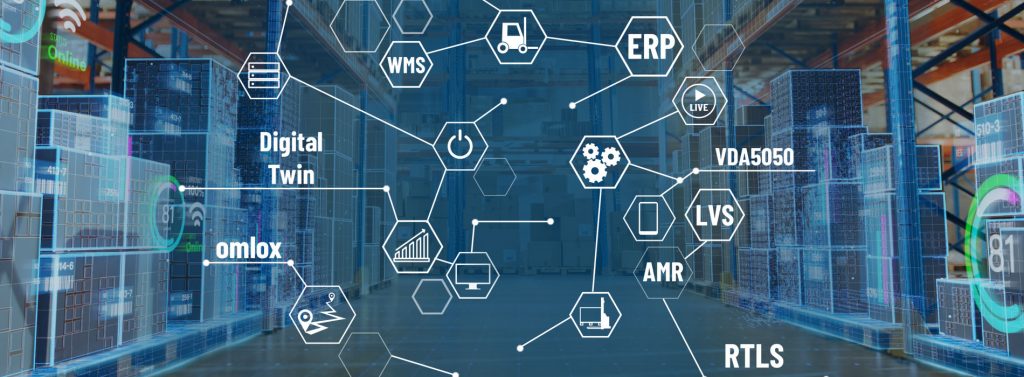
Real-time production planning: AI-supported control of the material flow

Everything at a glance: The digital twin in intralogistics

1.5 Million Reasons for Greater Transparency: How Digital Container Cycles Are Transforming Industries
What is the difference between WMS, WCS, and WES?

 Speak directly