

Updated on 30. September 2026
A Compact Look at the Benefits of SAP® and WES Working Together
More Functions, More Responsibilities: SAP EWM®
SAP WM® is being phased out. Anyone still working with it needs to switch — at the latest by 2027, when ECC maintenance also ends. Anyone implementing a new system or currently growing will end up with SAP EWM® anyway. The question is simply when.
As a warehouse management system, SAP EWM® controls transport orders, manages storage locations at bin level, communicates with production and posts warehouse movements. So far, so good but the reality in many operations looks different. EWM is running, processes are defined, interfaces are in place but the warehouse data is wrong. Bookings are missing, inventory levels deviate, the system shows goods that have long since been relocated. Planners distrust the data. Operators work from memory rather than from the system. And the EWM that was supposed to orchestrate the warehouse is planning based on a current state that no longer exists.
Read this article if:
Summary:
The Prerequisite: Valid Real-Time Data
SAP EWM® is only as good as the data it receives. And in manufacturing companies, this data comes from many different sources which is, at first glance, good news. Conveyor technology books automatically when goods pass through. MES systems report finished quantities from production. Automated warehouse systems log their own movements. All of this — and more — flows into EWM.

Goods receipt
But things become more complicated at the goods receipt stage. Companies with a connected TMS and standardised delivery notifications receive clean data. Companies working with many different suppliers who bring along different systems, different labels and different data formats face a different reality: manual recording, scanning during unloading, manually capturing delivery notes. Every exception is a potential source of error that flows directly into EWM.

Relocation vs. manual scanning
Then the actual blind spot emerges: manual tracking and follow-up. As soon as a forklift truck operator picks up or relocates a pallet and places it in a free storage area, the data chain breaks again. This moment is not captured automatically. It happens hundreds of times every day. The operator is under time pressure. The barcode is damaged. The Wi-Fi in the back section of the warehouse is unstable. The pallet is quickly relocated, the booking put off until later and then forgotten. Why this is a structural problem rather than a training issue is explained in our practical question How can I operate SAP EWM® with less scanning effort?
Data hygiene
The result accumulates quietly. EWM shows goods at location A3 that have long since been moved to B7. It allocates material that cannot be found. It sends operators on search runs. Every correction costs time. Every stocktake temporarily clears the data backlog until it builds up again. This is not an EWM problem and not an MES problem. It is a structural gap between the systems that book reliably and the moments in between, where a person with a scanner has to make the decision.
Scenario 1: Migration from SAP WM® to SAP EWM®
Anyone migrating from SAP WM® to EWM expects progress. The system becomes more modern, the functionality more extensive, the integration deeper. What many only discover once the system is live: EWM demands more from the warehouse than WM — not less.
In SAP WM®, booking processes were often coarser-grained. One movement, one scan, done. SAP EWM® operates at handling unit level and tracks warehouse movements in far greater detail which is fundamentally an advantage, but also means more booking steps per transaction. More steps mean more interaction points. More interaction points mean more places where a scan can be missing, incorrect or arrive too late. Anyone who sees the migration as an opportunity to solve the data problem experiences the opposite: the requirements for data quality increase, but the way data is generated stays the same. The forklift truck operator is still standing in front of the pallet with a scanner.
Then there is the goods receipt stage. If the TMS is not connected or suppliers deliver with different systems and labels, the data backlog does not start in the warehouse it starts at the gate. Legacy data from WM that is transferred to the new EWM often already contains inconsistencies.
In Practice. How Refresco and Warsteiner Solved It
Refresco!
Refresco
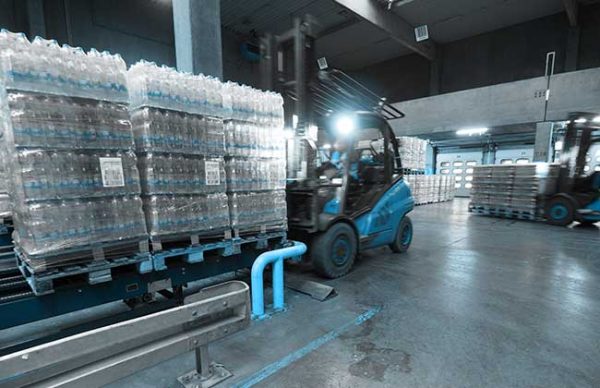
Refresco migrated from SAP WM® with hand scanners to SAP EWM® and simultaneously implemented the identpro Warehouse Execution System (WES).
The data gap in EWM was thereby closed. The result: a cleaner migration, 25% more pallet throughput with an unchanged fleet and 50% fewer empty runs.

Warsteiner
Warsteiner’s goal: full transparency over full and empty goods inventories across two sites, complex returnable container handling, and scan-free internal transport between the Warstein and Paderborn sites. The solution was the direct integration of the identpro WES into SAP EWM®. All warehouse movements are captured automatically and posted back to EWM without any manual intervention. Confirmations are fully automatic.
Scenario 2: New SAP EWM® Implementation Without Migration
Many companies start directly with SAP EWM® because they are growing, because they are replacing an outdated standalone solution, because they want to professionalise, or because they are digitalising their warehouse as part of an S/4HANA implementation.
The starting point is different but the underlying problem is the same.
Anyone implementing SAP EWM® from scratch has no legacy data backlog from a previous system. Instead, they have something else: employees who have never worked with digital warehouse control. Processes that still need to be defined. And a goods receipt area that is supposed to book cleanly from day one including with suppliers who may not support that. The expectation is often: we are starting fresh, we will do it right from the beginning. The reality of the ramp-up phase frequently looks like this: incorrect bookings caused by unfamiliar processes, scan errors because employees do not yet know the system, data inconsistencies that build up in the first few weeks and burden the new EWM with the same problems that were supposed to be avoided.

There is also an additional factor that is often underestimated: companies implementing EWM from scratch are frequently in the middle of growth at the same time. New employees, new warehouse structures, higher volumes. At precisely the point where everything is new simultaneously, the error rate is highest and the consequences of inaccurate warehouse data are most expensive.
Some of these companies find identpro during the ERP evaluation phase. Before SAP EWM® has even been decided upon, they are already exploring how reliable warehouse data is generated in the first place. This is the optimal entry point, because it allows the WES and EWM to be conceived as a system from the outset not as a retrospective addition. Others come across identpro in the middle of the EWM implementation, when the first data gaps become visible. This also works but it means an additional integration step in a project that is already complex.
In both cases: anyone implementing EWM from scratch has the rare opportunity to build a clean data foundation from the very beginning. Taking this opportunity does not mean starting a second major project it means thinking of the WES as an integral part of the EWM implementation.
The Change Management Trap: Too Many Systems at Once
What happens in practice when several systems are introduced simultaneously: employees are overwhelmed because too much is new at once. Anyone who implements the WES first gives their employees time to get used to digital warehouse control in a familiar environment, with the existing ERP as a safety net. When EWM arrives, digital control is no longer a new concept. Employees know the terminal, trust the system and are already working without scanning. The EWM rollout takes place on a stable foundation, with a team that is already working digitally and supplying EWM with reliable warehouse data from day one.
Valid Data Before Control: Why WES Before SAP EWM® Works So Well
EWM is a system that plans and controls. Anyone who implements it without first clarifying the baseline is building on a foundation that is unstable from the start. Anyone who implements the WES first lays that foundation — deliberately, in a controlled manner and without the time pressure of a live ERP project.
Concretely, this means:
All warehouse movements are captured automatically: without scanning, without manual intervention, without dependency on the behaviour of individual employees.
- EWM starts with warehouse reality: Once goods enter the warehouse, they are tracked to the centimetre from that moment on.
- Employee satisfaction / system acceptance: They learn digital warehouse control without simultaneously being confronted with new SAP® booking logic. Trust in the system grows.
- Importantly: The WES is not a SAP® support tool. It is an independent system that solves problems that go far beyond SAP®: reducing empty runs by up to 30%. Eliminating search times. Drastically shortening the onboarding time for new employees.
- The WES controls: 100% inventory transparency that works regardless of which ERP system sits behind it.
What the WES Means for the IT System Landscape
For IT, integrating the WES is significantly leaner than classic SAP® projects. No custom development required, no infrastructure modifications. Existing forklift trucks are retrofitted with an IoT kit. The system runs via Wi-Fi or LTE and is compatible with SAP ECC® and SAP S/4HANA® — both with embedded EWM and decentralised EWM. As a cloud-based SaaS solution, go-live is significantly faster than with classic SAP® projects and requires no complex IT infrastructure. Open standards such as VDA5050 ensure investment security and prevent vendor lock-in. For SAP EWM® integration, identpro works with certified partners, including prismat.
Frequently Asked Questions (FAQ)
Are you planning SAP EWM® or still considering your options?
Talk to us about what this looks like concretely in your warehouse and how other companies like Warsteiner and Refresco have successfully implemented the combination of SAP EWM® and the identpro WES.

SAP WM® to SAP EWM® or a Fresh Start? Without Valid Warehouse Data, Nothing Works!

Why Classic RFID and Barcode Systems Are Reaching Their Limits in Chemical Warehouses
What is the difference between WMS, WCS, and WES?

Challenges for Supply Chain Management 2026

Real-Time Visibility in Building Materials Logistics

How to digitize my warehouse processes: In four steps

1.5 Million Reasons for Greater Transparency: How Digital Container Cycles Are Transforming Industries

Guidance First: From Data Foundations to the Roof of the Automated Warehouse

Tracking Supply Chains in Paper Manufacturing Plants with Real-Time Data

 Speak directly